


Hanoi or Halong Bay – Which destination fits your travel style?
Choosing between Hanoi or Halong Bay is a common question for travelers coming to northern Vietnam, especially when time is limited. While the two destinations are not very far from each other, the travel experience they offer is completely different. Hanoi represents urban life, history, street culture, and a dense collection of attractions that can fill your schedule from morning to night. Halong Bay, in contrast, is centered around natural scenery, cruises, and time spent on the water. Understanding these differences will help you decide where your days are better invested.

Choosing between Hanoi or Halong Bay is a common question for travelers coming to northern Vietnam, especially when time is limited. While the two destinations are not very far from each other, the travel experience they offer is completely different. Hanoi represents urban life, history, street culture, and a dense collection of attractions that can fill your schedule from morning to night. Halong Bay, in contrast, is centered around natural scenery, cruises, and time spent on the water. Understanding these differences will help you decide where your days are better invested.
Hanoi or Halong Bay at a glance
If you're hesitating between Hanoi or Halong Bay, the easiest way to start is by looking at the kind of experiences each destination naturally offers. While they are both located in northern Vietnam and often included in the same trip, the atmosphere, pace, and highlights can feel worlds apart.
Hanoi is vibrant, historical, and deeply cultural. Travelers come here for bustling Old Quarter streets, centuries-old landmarks, museums, traditional performances, and one of the most famous street food scenes in Asia. Days are usually filled with walking, exploring, tasting, and observing everyday local life.
Hanoi or Halong Bay at a glance (Source: Sapa Nomad)
Halong Bay, on the other hand, is all about scenery and relaxation. The main highlight is cruising among thousands of limestone islands, kayaking through calm waters, visiting caves, and enjoying the changing colors of the sea from sunrise to sunset. Instead of traffic and city sounds, you get open views and quiet moments on the water.
In short, Hanoi rewards curiosity and cultural exploration, while Halong Bay focuses on natural beauty and slow, scenic travel.
Still can’t decide between Hanoi or Halong Bay? The Highlight Hanoi – Halong Bay – Tam Coc 4 Days tour by Sinhcafe is designed exactly for travelers who don’t want to choose. Instead of rushing between destinations, this itinerary blends cultural discovery, natural scenery, and immersive local experiences into one well-paced journey. From the vibrant streets of Hanoi to the dramatic seascapes of Halong Bay and the peaceful beauty of Tam Coc, every stop is optimized to give you maximum value for your time. It is the ideal solution for first-time visitors who want a balanced Northern Vietnam experience without the stress of planning.
Read more: Hanoi or Da Nang? A detailed comparison to choose the right destination
Sightseeing experiences and travel activities
When comparing Hanoi and Halong Bay, the biggest difference lies in how you spend your days. In Hanoi, most of your time is dedicated to moving around the city, walking between attractions, visiting historical sites, eating, and observing local life. In Halong Bay, the journey usually revolves around cruises, natural scenery, and water–based activities. Because of that, the pace of travel and the overall feeling after each day can be very different.
Below are the typical experiences travelers can expect in each destination.
Hanoi
In Hanoi, you rarely do just one thing in a day. Your morning might start with a historical visit, followed by lunch at a local restaurant, an afternoon walk around the lake, and another outing in the evening. Since many attractions are located close to one another, sightseeing often happens continuously, mixed with breaks at cafés or street food stalls. The city suits travelers who enjoy moving around, observing daily life, and fitting many experiences into a limited time.
Historical & Cultural landmarks
Hanoi has a high concentration of heritage sites, especially in the central districts. Many visitors begin with the Temple of Literature, where you can walk through courtyards, see the stone steles of scholars, and learn about Vietnam’s ancient education system. Not far away is the Imperial Citadel of Thang Long, a UNESCO World Heritage Site featuring archaeological areas and historical remains from different dynasties.
Another popular complex is the Ho Chi Minh Mausoleum, together with the Presidential Palace and One Pillar Pagoda. Visits here follow certain rules and queues, and travelers usually spend time understanding modern Vietnamese history.
Experiences at these places often involve a fair amount of walking, reading information boards, listening to guides, and taking photos.
The Old Quarter & Daily urban life

The Old Quarter in Hanoi (Source: Nhan Dan news)
The Old Quarter is where visitors most clearly feel the rhythm of Hanoi. Streets are narrow, motorbikes are everywhere, shops stand side by side, and sidewalk eateries operate from morning until late. You can easily spend hours wandering from one street to another, browsing souvenirs, checking tailor shops, or simply trying any dish that catches your eye. Many travelers enjoy sitting at a small café balcony, watching the constant flow of traffic below, a simple activity, yet one that leaves a lasting memory of the city.
Lakes, parks and relaxing stops
Between sightseeing sessions, travelers often head to open spaces such as Hoan Kiem Lake or West Lake. These areas are ideal for walking, resting, or escaping the crowded streets.
Around West Lake, you will find wider roads, cafés, and restaurants, making it pleasant for cycling or sunset watching. Meanwhile, Hoan Kiem Lake is easier to combine with shopping and food stops.
Night activities & Entertainment
In the evening, central Hanoi becomes livelier. On weekends, the walking street area around the lake hosts performances, street music, and public activities for all ages.
Many visitors choose to explore local restaurants, try more dishes, or head to Ta Hien Street for drinks. For a cultural option, the water puppet show is a common choice thanks to its short duration and easy accessibility.
Overall, nightlife in Hanoi focuses more on strolling and eating rather than large-scale entertainment complexes.
If your travel style aligns more with culture, history, and everyday local life, starting with a Full-Day City Tour in Hanoi is one of the best ways to understand the capital beyond the surface. Rather than navigating the busy streets on your own, Sinhcafe’s guided experience takes you straight to the city’s most meaningful landmarks while providing context that brings each location to life.
Halong Bay
Unlike Hanoi, experiences in Halong Bay usually follow the stages of a cruise journey. You won’t need to constantly find directions or move between separate attractions because most schedules are pre-arranged. The day is divided between sightseeing, outdoor activities, and relaxing on board. This rhythm makes the trip feel more restful.
Cruise journey through the limestone islands
Most travelers visiting Halong join a boat tour, either for a day trip or an overnight stay. Once the cruise departs, you travel among thousands of limestone formations of different shapes and sizes.

Cruise journey through the limestone islands (Source: Collected)
Time on board typically includes meals, relaxing on the sundeck, taking photos, and listening to explanations about upcoming stops. Instead of continuous movement like in a city, the experience here is slower and centered on enjoying the landscape.
Famous caves and panoramic views
Many cruise routes include a visit to Sung Sot Cave, where you follow prepared pathways through enormous chambers. Lighting makes exploration easier, but you should still expect stairs and walking.
At Titop Island, the highlight is hiking to the viewpoint for a panoramic look over the bay, then returning to the small beach for swimming or relaxing.
Kayaking and close-to-water experiences
In calmer areas, visitors can go kayaking. Paddling on your own allows you to approach cliffs, pass through narrower passages, and experience quieter surroundings compared to staying on a large boat.
For many travelers, this becomes one of the most memorable parts of the trip.
Attractions in Halong city
If you spend time in the city itself, Sun World Halong Complex is a major attraction, featuring amusement rides, a cable car, and a giant observation wheel. In the evening, visitors often walk along the waterfront or enjoy seafood dinners. However, for most tourists, these city activities are secondary to the main experience of exploring the bay.
Read more: Halong Bay travel guide 2025: Best time, tips & top things to do
Location and ease of transportation
For many travelers, especially first–time visitors to Vietnam, an important question is not only which place is more beautiful, but also how easy it is to get there, how complicated it is to move around, and what destinations you can reach next. Time spent in transit, the number of transfers, or whether you must depend on a tour can directly shape the quality of your trip.
Hanoi and Halong Bay represent two very different types of convenience. One is a major transportation hub with flexible independent travel options. The other becomes simple once you arrive, because most activities are already connected to the harbor and cruise routes.

Location and ease of transportation (Source: Collected)
Hanoi
Hanoi is the most common gateway to Northern Vietnam. Many itineraries start here before travelers branch out to other regions.
Is it easy to reach Hanoi?
Noi Bai International Airport is located about 25–30 km from the city center. Every day, there are numerous domestic flights from Ho Chi Minh City, Da Nang, Nha Trang, Phu Quoc, and more, along with international routes from Korea, Japan, China, Thailand, Singapore, and Europe.
After landing, you can:
- take a taxi or ride-hailing car (around 30–45 minutes depending on traffic)
- use an airport bus for a lower budget
- or arrange a private transfer if traveling in a group
Entering the city is straightforward, with no complicated transit steps.
Besides air travel, Hanoi is also the main hub of the North–South railway and long-distance bus systems, making overland access very convenient.
Is it difficult to get around in Hanoi?
If you stay near the Old Quarter – Hoan Kiem Lake, many attractions such as St. Joseph’s Cathedral, Dong Xuan Market, or the Opera House are within walking distance.
For places slightly farther away like the Temple of Literature, Ho Chi Minh Mausoleum, or the Imperial Citadel, taxi and ride-hailing trips are still short and manageable.
One thing to expect is heavy traffic during rush hours, which can slow you down. Travelers familiar with big cities usually find it normal, but those seeking a relaxing vacation may feel a bit tired.
Is Hanoi convenient for traveling onward?
This is one of Hanoi’s biggest strengths.
From the capital, you can easily arrange transport or tours to:
- Halong Bay – about 2.5–3 hours
- Ninh Binh (Trang An, Tam Coc) – around 2 hours
- Sapa – 5–6 hours via highway or overnight train
- Ha Giang – for longer mountain journeys
- Mai Chau, Moc Chau
Many operators offer hotel pick-up, so connections are smooth.
Halong Bay
Halong Bay is convenient in a different way: you spend a few hours getting there, but once you arrive, the rest of the journey becomes simple.
How do you get to Halong Bay?
Most international visitors:
- Fly to Hanoi
- Continue by road to Halong
Common options include limousine vans, tourist shuttle buses, or private cars. Thanks to the expressway, travel time is usually 2.5–3 hours. Many companies pick you up directly from hotels in the Old Quarter.
Halong also has Van Don Airport, but flight availability is more limited, so most travelers still use Hanoi.
What happens after you arrive?
If you book a cruise, vehicles normally drop passengers near the harbor. From that moment, the itinerary is managed by the cruise company. You do not need to calculate routes, find taxis, or plan transfers between attractions.
If you stay in Bai Chay, restaurants, cafés, the night market, and some entertainment spots are relatively close together.
Is Halong a good base for other destinations?
In reality, most travelers:
- return to Hanoi for their flight
- or move on to other northern provinces
Halong is usually considered a highlight stop within an itinerary, rather than a transportation base for multiple onward trips.
In practical terms, if you prefer flexibility, spontaneous plan changes, and combining many destinations in one journey, Hanoi offers clear advantages.
If you want everything arranged in advance and to start your activities immediately upon arrival, Halong Bay helps reduce planning effort.
If you are leaning toward Halong Bay after reading this guide but worry about time, logistics, or choosing the right cruise, the Halong Bay Cruise 1 Day by Sinhcafe is a smart, hassle-free option. Perfect for travelers with limited schedules, this tour lets you experience the bay’s iconic limestone karsts, emerald waters, and scenic caves without committing to an overnight stay. With transportation, meals, and activities carefully arranged, you can enjoy one of Vietnam’s most breathtaking landscapes while keeping your itinerary efficient and your budget under control.
Food experiences when traveling
Food is one of the elements that often makes travelers hesitate between Hanoi or Halong Bay. The two destinations offer very different culinary identities: one is famous for long-established Northern Vietnamese classics, while the other stands out thanks to fresh seafood from the coast.
Because of this, the choice usually depends on whether you want to explore the depth of traditional cuisine or focus on enjoying ocean ingredients prepared in a local style.
Hanoi
Hanoi is where many dishes that later became symbols of Vietnamese cuisine can be found. Names such as pho, bun cha, bun rieu, bun thang, cha ca, spring rolls, and banh cuon are widely available, and there are often multiple well-known versions of the same dish. Travelers can even try one specialty at different restaurants to notice small differences in flavor and preparation.
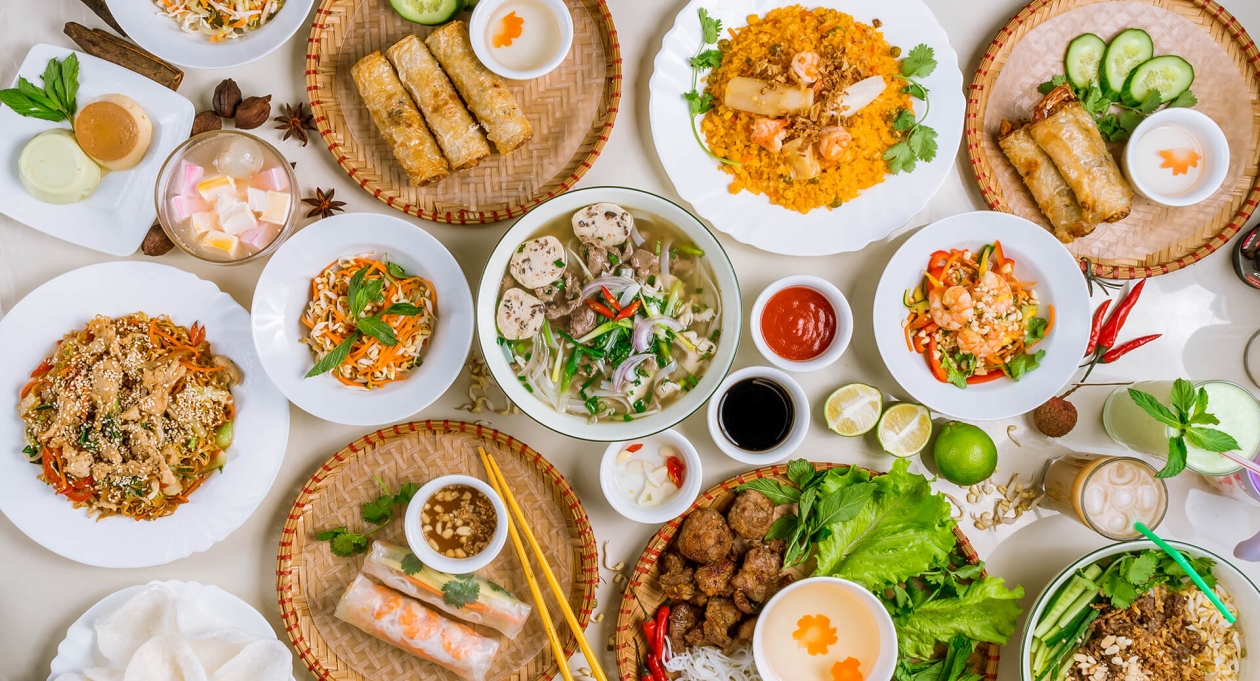
Food in Hanoi (Source: Vietnam Tourism)
The taste in Hanoi is typically balanced — not too spicy, not too sweet — which makes it approachable for international visitors. Beyond main meals, snacks and drinks are also part of the attraction. Tea, egg coffee, desserts, and street-side treats make it easy for visitors to keep discovering new flavors over several days without feeling repetitive.
Halong Bay
If Hanoi is strong in culinary heritage, Halong Bay is best known for seafood. Crab, shrimp, squid, mantis shrimp, and oysters are commonly caught locally and served steamed, grilled, stir-fried, or in hotpots. For many travelers, this is a good opportunity to enjoy fresh marine products at prices that are often more reasonable than in other coastal tourist destinations.
Halong Bay still offers popular Northern Vietnamese dishes, but the overall range is naturally smaller than in a large capital city. Instead, the highlight lies in ingredient freshness and meals that clearly reflect the character of a seaside area.
Weather and best time to visit
Weather can significantly influence the decision between Hanoi or Halong Bay, especially because the two places react differently to seasonal changes even though they are located in the same northern region of Vietnam.
Hanoi has four distinct seasons. Spring (March–April) and autumn (September–November) are generally considered the most comfortable, with mild temperatures, lower humidity, and good conditions for walking and sightseeing. Summer can be very hot and humid, with occasional heavy rains, while winter may turn cold and gray, sometimes below what many travelers expect in Southeast Asia. Still, city-based activities continue year-round, and transportation is rarely affected by weather.

The best time to visit Halong Bay is usually from October to April (Source: Collected)
Halong Bay is more sensitive to climate conditions. Cruises, kayaking, swimming, and scenic views depend heavily on visibility and sea status. The best period is usually from October to April, when the air is cooler and skies are clearer. During summer months, tropical storms or strong winds may lead to cruise adjustments or cancellations. Fog in winter can also limit views, although some travelers enjoy the quieter, more mysterious atmosphere.
Travel costs and pricing
Budget is another practical factor when weighing Hanoi or Halong Bay, and the spending structure between the two destinations is quite different.
In Hanoi, prices are flexible. Accommodation ranges from budget hostels to luxury hotels, street food can be very affordable, and entrance tickets to historical or cultural sites are usually low. Transportation inside the city is also reasonably priced thanks to taxis, ride-hailing apps, and public buses. Because there are many choices, travelers can easily control daily expenses depending on their comfort level.
Halong Bay, on the other hand, often requires a bigger upfront budget, mainly because cruises are the highlight of the experience. Packages may include transportation, meals, accommodation on board, and activities, which makes pricing less flexible. While day trips are cheaper, overnight cruises can quickly increase total costs. Dining and services in tourist-focused areas also tend to be higher compared to typical city prices.
In the end, the choice between Hanoi or Halong Bay depends on what you expect from your trip. If you enjoy walking through neighborhoods, visiting historical landmarks, and exploring a wide range of food options, Hanoi may suit you better. If your priority is dramatic landscapes, cruising between limestone islands, and spending time surrounded by nature, Halong Bay is hard to beat.
Share via




Related articles

Visit Quan Thanh Temple Hanoi to uncover its legends and historical treasures
Posts | 03/12/2025

Common Hanoi Scams and How to Avoid Them
Posts | 19/09/2026

Travel to Vietnam with Kids: The Complete Family Travel Guide
Posts | 26/06/2026
Book Street Hanoi: A New Tourism Destination for Book Lovers
Posts | 26/01/2026








There are no reviews yet