


Phuc Kien Assembly Hall in Hoi An: History, Architecture and Visitor Guide
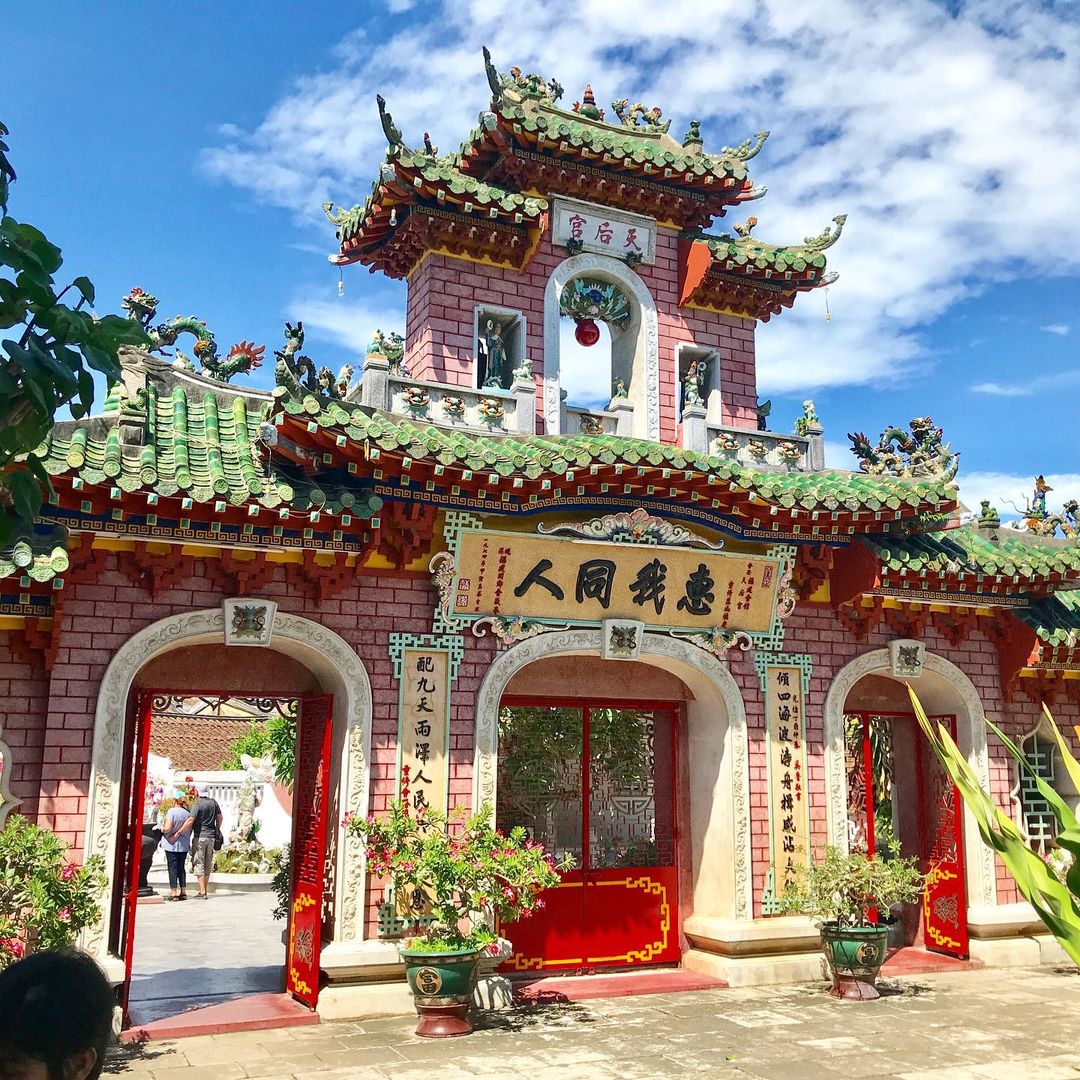
Located in the heart of Hoi An Ancient Town, Phuc Kien Assembly Hall is more than just a historic building. It stands as a lasting symbol of the Chinese community’s cultural and spiritual presence in the old trading port. Built by Fujian merchants centuries ago, this guide explores the hall’s history, architectural highlights and essential visitor information to help you better appreciate it.
Introduction to Phuc Kien Chinese Assembly Hall
Phuc Kien Chinese Assembly Hall, also known as Fujian Assembly Hall, is one of the most prominent Chinese assembly halls in Hoi An Ancient Town. Built by the Fujian Chinese community, the hall stands as a lasting reminder of Hoi An’s past as a thriving international trading port where different cultures met and flourished.
For generations, the assembly hall has played an important role in the Chinese community in Hoi An. It served as a shared space where people gathered, maintained social connections and preserved cultural traditions while living and working far from their homeland.

Phuc Kien Assembly Hall (Source: Hoi An Heritage)
Today, Phuc Kien Assembly Hall remains a meaningful cultural and spiritual site for both locals and visitors. Beyond its architectural beauty, the hall offers travelers a glimpse into the religious beliefs and cultural values that continue to shape life in Hoi An, making it a significant stop when exploring the ancient town.
Where is Fujian Assembly Hall? How to get to?
Located in the heart of Hoi An Ancient Town, Fujian Assembly Hall is easy to reach and conveniently included in most walking itineraries around the old quarter. Thanks to its central position, visitors can combine a visit here with nearby heritage sites without needing additional transportation.
Location of Phuc Kien Assembly Hall
- Official name: Fujian Assembly Hall (Phuc Kien Assembly Hall / Hoi Quan Phuc Kien)
- Address: 46 Tran Phu Street, Hoi An Dong Ward, Hoi An
- Opening hours: 8:00 AM - 5:00 PM daily
Situated on Tran Phu Street, one of the main heritage roads in the Ancient Town, the assembly hall is surrounded by other historic houses, museums and temples, making it a natural stop during a walking tour of Hoi An.
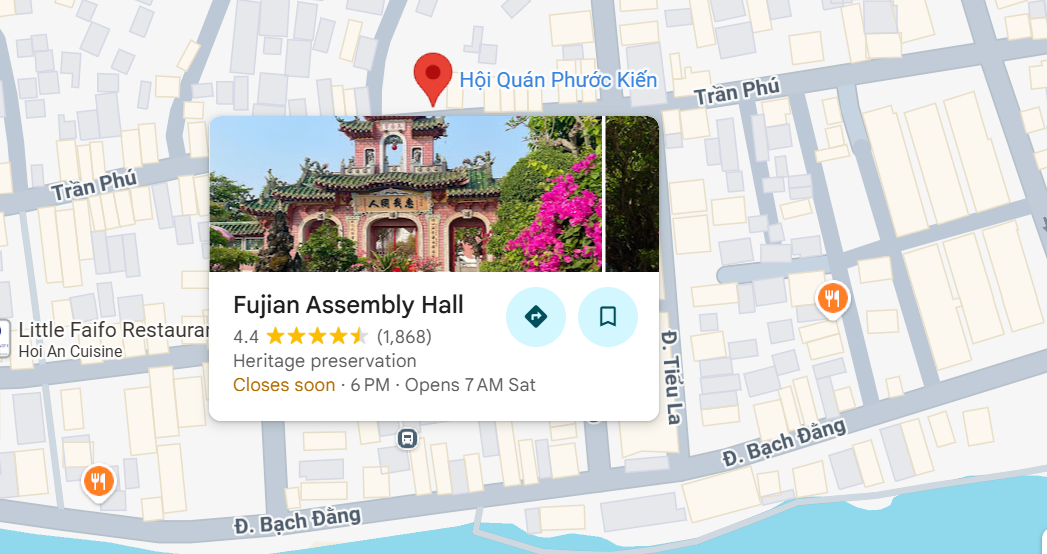
Location of Fujian Assembly Hall
How to get there from Da Nang or Hoi An
Thanks to its central location in Hoi An Ancient Town, Fujian Assembly Hall is easy to reach with various transportation options, whether you are traveling from Da Nang or already staying in Hoi An.
From Da Nang
- By taxi or private car: This is the most convenient option for travelers coming from Da Nang. The journey to Hoi An takes around 45-60 minutes, depending on traffic. Once you arrive near Hoi An Ancient Town, you can park outside the pedestrian zone and walk to Fujian Assembly Hall.
- By shuttle bus or tourist bus: Many hotels and travel agencies in Da Nang operate shared shuttle buses to Hoi An. These usually drop passengers near the Ancient Town, from where it is just a short walk to Tran Phu Street and the assembly hall.
- By motorbike: For independent travelers, renting a motorbike offers flexibility and scenic coastal views along the way. Travel time is about 1 hour. Parking is available outside the Ancient Town, after which you can explore the area on foot.
From Hoi An
- On foot: If you are already in Hoi An Ancient Town, walking is the best way to get there. From the Japanese Covered Bridge, it takes only about 6 minutes along Tran Phu Street to reach Fujian Assembly Hall.
- By bicycle: Cycling is a popular option in Hoi An, especially if you are staying just outside the Ancient Town. You can park your bicycle near the entrance and continue walking inside the heritage zone.
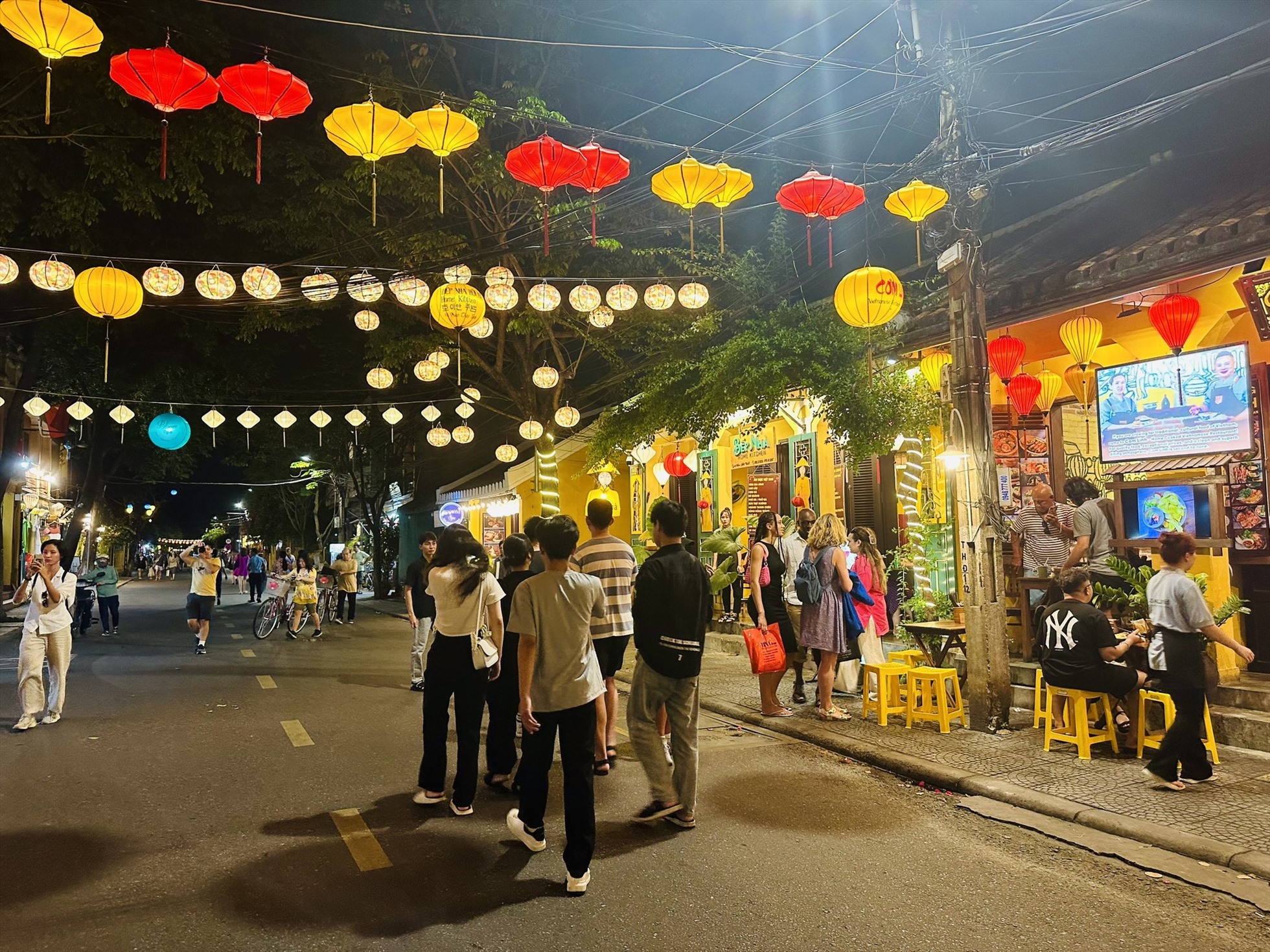
Visitors walking on foot in Hoi An (Source: Bao Lao Dong)
History and origin of Phuc Kien Assembly Hall
Phuc Kien Assembly Hall (Hội Quán Phúc Kiến) is closely linked to the early formation and prosperity of Hoi An as an international trading port from the 17th century. It represents the history of the Fujianese community, the largest and earliest Chinese group to settle in Hoi An.
According to historical records and local tradition, the site was originally a small shrine known as Kim Son Pagoda, built by local residents in the late 17th century to worship a Buddhist statue believed to have drifted ashore. In 1697, during Hoi An’s peak as a commercial hub, Fujian merchants purchased the land and converted the shrine into a communal space for their compatriots. At this time, the structure still retained its original name, Kim Son Pagoda.

The Fujian Assembly Hall in the past (Source: 36pho.com)
As the Fujianese population grew, the site gradually evolved into an assembly hall serving multiple purposes, including community gatherings, religious worship and mutual support among merchants and settlers. In 1757, a major restoration marked a turning point in its history, when the wooden structure was rebuilt with brick walls and tiled roofs, officially becoming Phuc Kien Assembly Hall as it is known today.
From that point onward, the hall became dedicated primarily to the worship of Thiên Hậu Thánh Mẫu (Mazu), the Goddess of the Sea, reflecting the maritime roots of the Fujianese people and their reliance on safe sea voyages for trade. Over the centuries, the assembly hall underwent several restorations while maintaining its original spiritual role.
In 1990, Phuc Kien Assembly Hall was recognized as a National Historical and Cultural Monument of Vietnam, affirming its historical significance. Since the 1980s, it has also been opened to visitors, allowing travelers today to better understand the Chinese heritage that helped shape Hoi An’s multicultural identity.
As one of the earliest Chinese assembly halls established during Hoi An’s peak trading era, Phuc Kien Assembly Hall is often visited alongside other historical landmarks that trace the development of Central Vietnam’s cultural heritage. If you’re planning to explore attractions beyond Hoi An, this site naturally fits into a broader journey through the region.
For travelers who prefer a well-organized itinerary, Sinhcafe Daily Departure: 5 Days 4 Nights in Central Vietnam offers a convenient way to experience destinations such as Da Nang, Hoi An, Hue and Ba Na Hills, with accommodation, guided sightseeing, transportation and entrance fees arranged in advance. This allows you to discover historical sites like Fujian Assembly Hall within a coherent and time-efficient travel experience.
What to expect when visiting Fujian Assembly Hall
A visit to Fujian Assembly Hall is not just about sightseeing but about stepping into a living cultural space shaped by centuries of belief, craftsmanship and community life. From its symbolic architecture to active worship practices, the hall offers visitors a layered experience that goes far beyond visual beauty.
Architecture of Phuc Kien Assembly Hall Hoi An
The architecture of Phuc Kien Assembly Hall is a remarkable example of traditional Chinese assembly hall design in central Vietnam. Originally constructed in 1697 entirely from wood, the complex was later rebuilt with brick walls and yin yang tiled roofs during a major renovation in 1757, giving the structure its enduring form today.
The hall follows a traditional Chinese architectural layout shaped like the character “Three”, extending longitudinally from Tran Phu Street toward Phan Chu Trinh Street. This layout creates a clear spatial sequence that guides visitors through layers of symbolic and functional spaces.
The Tam Quan gate is one of the most visually striking elements. Restored in 1975, it is richly decorated with porcelain mosaics, curved yin yang roof tiles and symbolic motifs. Above the gate, four red Chinese characters spell out “Phuc Kien Assembly Hall”, flanked by sun and moon symbols that represent heaven and earth and the harmony of yin and yang.
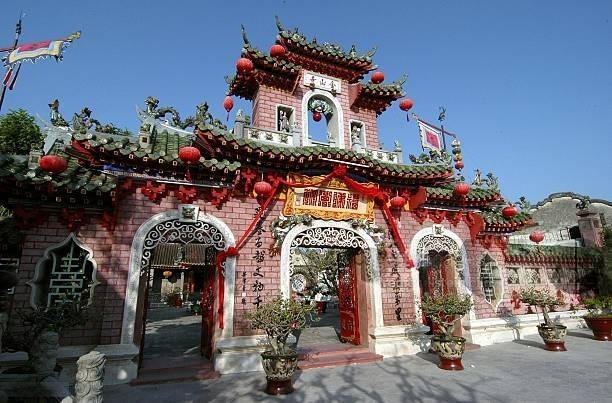
Tam Quan Gate
Throughout the complex, decorative details such as dragons, phoenixes, carp leaping over the dragon gate and the four sacred animals reflect wishes for prosperity, success and protection. These elements, combined with red columns, carved wooden beams and ceramic reliefs, highlight the refined craftsmanship of the Fujianese community and their strong spiritual worldview.
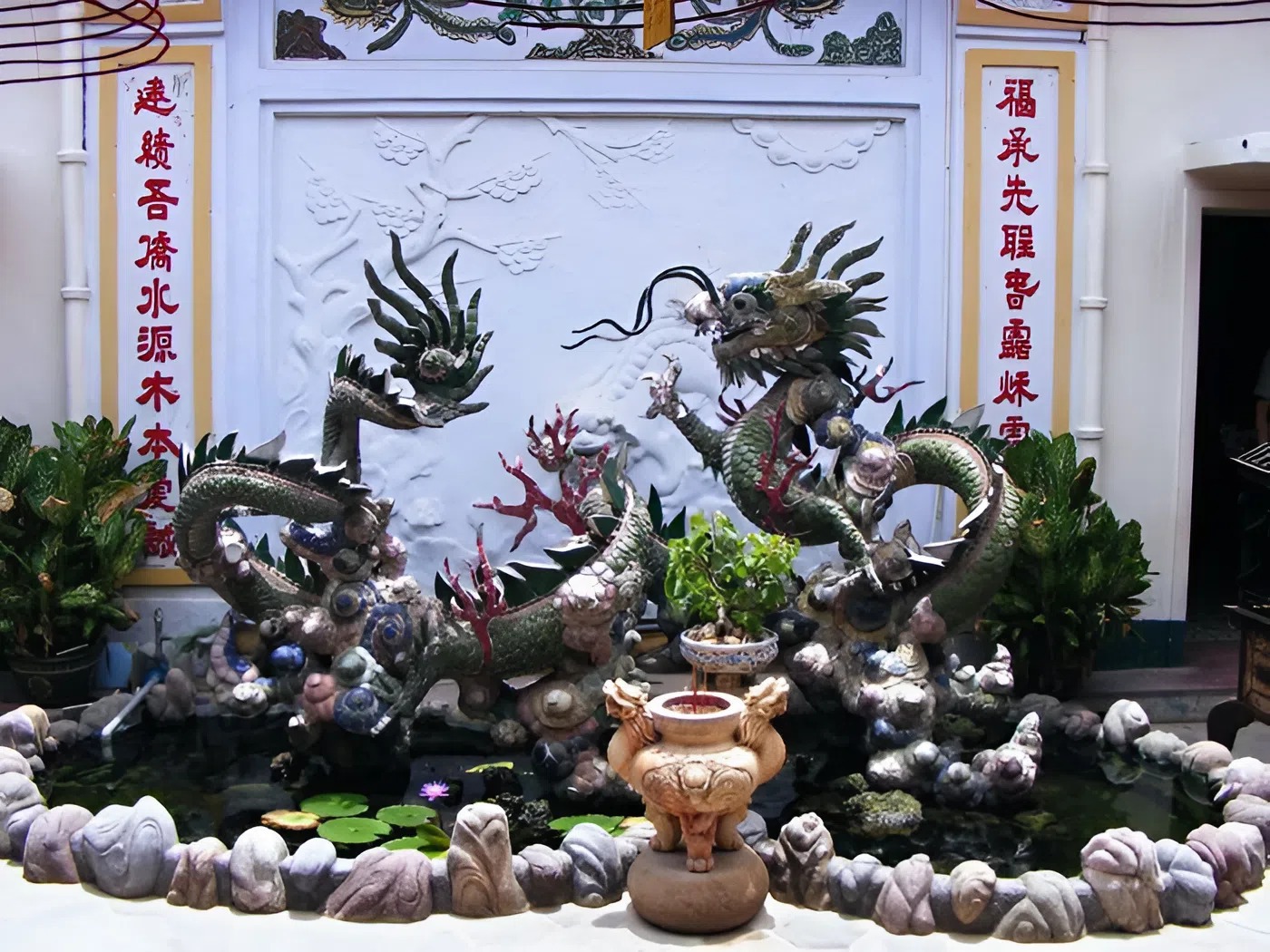
Images of the dragon, unicorn, tortoise and phoenix at the Fujian Assembly Hall (Source: Hiep Hoi Du Lich Quang Nam)
Main areas inside Phuc Kien Assembly Hall
Visiting Fujian Assembly Hall feels like moving through a carefully arranged sequence of sacred spaces, where architecture, symbolis and community life unfold layer by layer.
The Tam Quan Gate serves as a symbolic threshold rather than just an architectural landmark. Passing through its three entrances marks a clear transition from the lively streets of Hoi An into a calm and sacred environment. According to traditional belief, the three gates represent the harmony between Heaven, Earth and Humanity, reminding visitors that spiritual balance begins the moment they step inside.
Tam Quan Gate symbolizing harmony between Heaven, Earth and Humanity (Source: Dan Tri)
At the center of the gate, the Chinese inscription “Kim Son Tu” preserves the original name of the assembly hall, while the Sun and Moon guardian figures on either side embody the balance of yin and yang. The middle entrance, rarely opened except during major ceremonies, reinforces the idea that this space is not merely for sightseeing but for reverence and ritual.
As visitors walk through the side entrances, the atmosphere noticeably shifts as sounds soften, movements slow and attention naturally turns inward, preparing the mind for the sacred spaces beyond.
Beyond the gate, the front courtyard opens up as a tranquil area filled with bonsai trees, stone features and small water elements. Historically, this courtyard functioned as a meeting place where Fujian merchants gathered to discuss trade and community affairs.
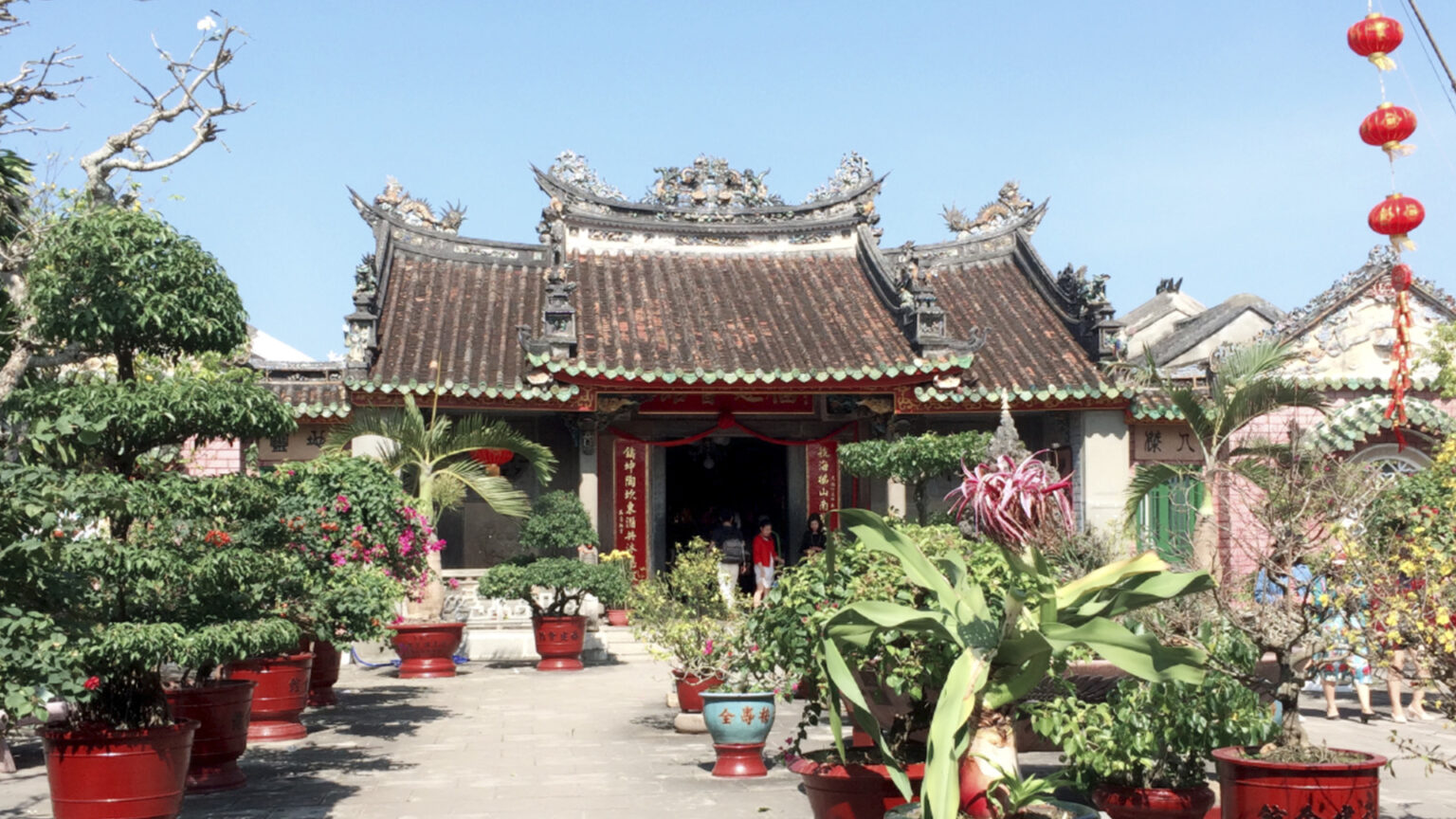
The front courtyard with bonsai trees (Source: Da Nang Fantasticity)
Today, it is best known for the large spiral incense coils suspended from the ceiling. These coils burn continuously for weeks, sometimes up to a month, carrying written wishes and prayers upward as the incense slowly fades. This practice remains one of the most visually striking and spiritually meaningful experiences for visitors.
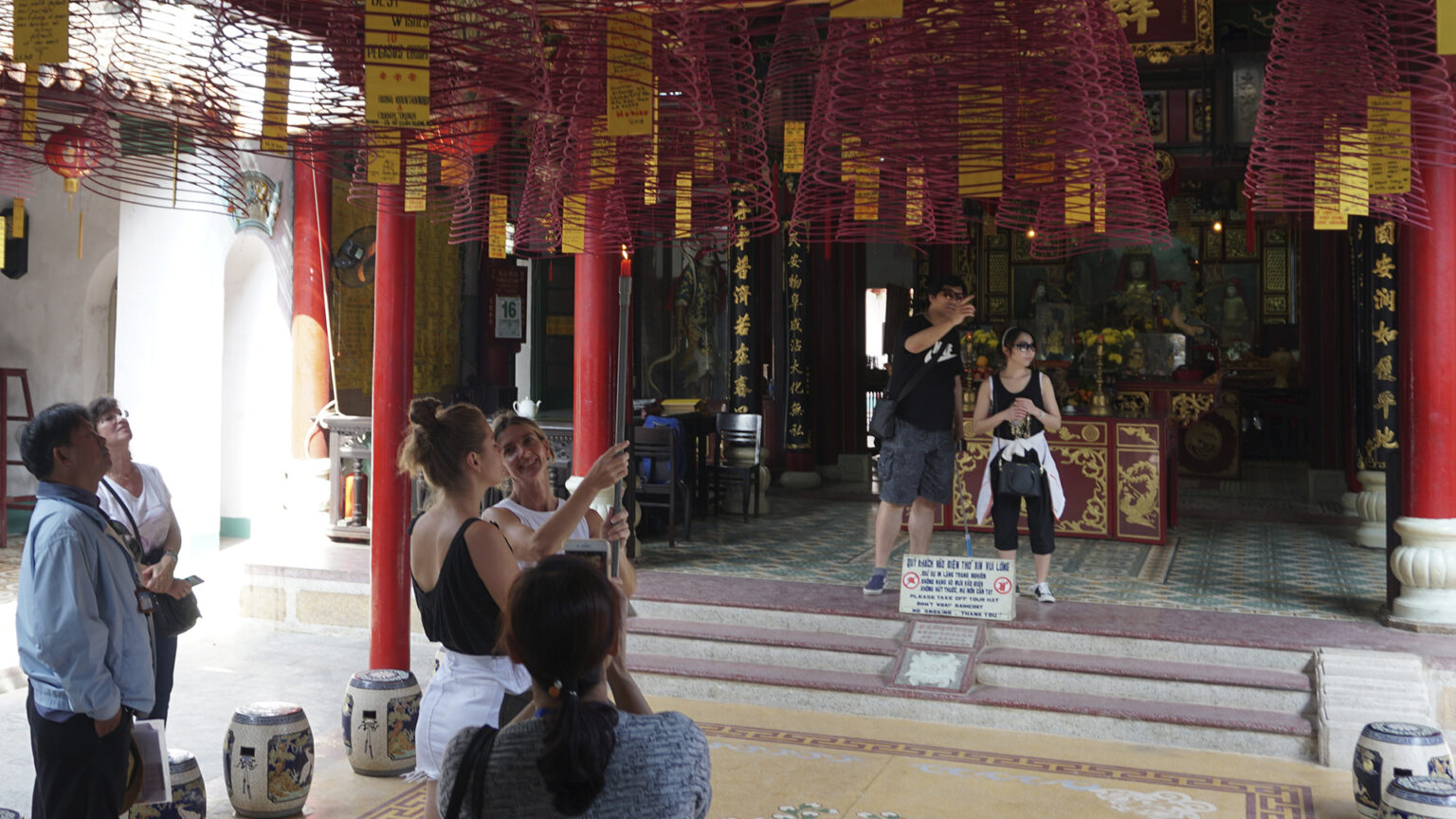
Visitors making wishes with large incense coils (Source: Da Nang Fantasticity)
At the heart of the complex lies the main hall, the most sacred and visually impressive area of Fujian Assembly Hall. The central altar is dedicated to Thiên Hậu Thánh Mẫu, also known as Mazu, the Goddess of the Sea, revered by generations of sailors and traders for protection during sea voyages.
Standing beside her are Thiên Lý Nhãn and Thuận Phong Nhĩ, two guardian deities believed to assist her by seeing and hearing across great distances.
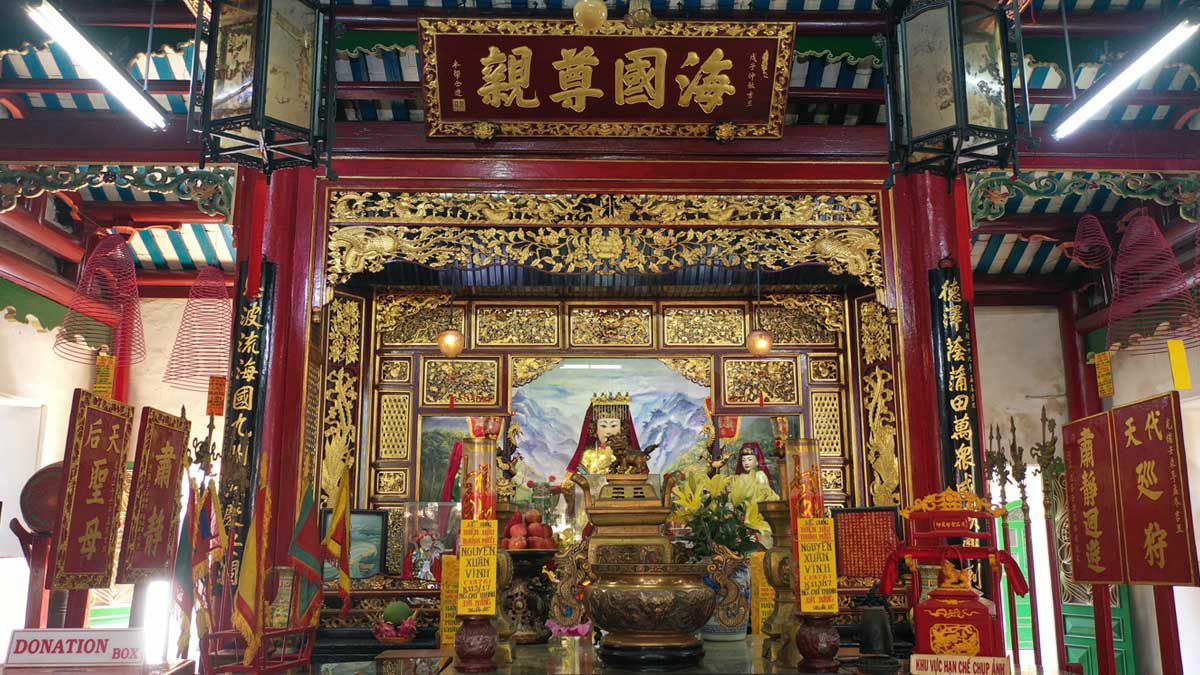
The main hall of Phuc Kien Assembly Hall (Source: Hoi An Heritage)
Nearby, a detailed model of a 19th century merchant ship, complete with painted eyes on its hull, reflects the traditional belief that vessels possess a spirit capable of sensing danger. The hall’s layout follows feng shui principles, creating a sense of balance intended to invite peace, good fortune and prosperity.

A 19th century merchant ship of Chinese people (Source: Hoi An Heritage)
Further inside, the back hall reveals the depth of the Fujian community’s spiritual life. This area is devoted to multiple altars honoring Lục Tánh Vương Gia, six revered Fujian generals, as well as the Twelve Midwives and the Three Goddesses of Childbirth, protectors of mothers and infants.
Additional shrines dedicated to deities associated with wealth, morality, life and death reflect the wide range of hopes once placed within this sacred space, from business success and safe travels to family harmony and healthy descendants.
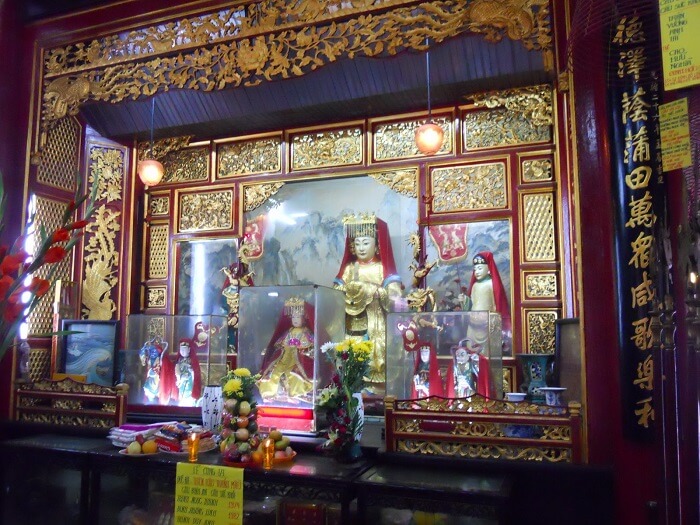
The back hall reveals the depth of the Fujian community’s spiritual life (Source: Hiep Hoi Du Lich Quang Nam)
Throughout the assembly hall, visitors can also observe numerous historical relics, including a bronze bell cast in 1790, ancient drums, incense burners, gilded wooden statues and finely carved Chinese plaques. Together, these artifacts offer a tangible connection to Hoi An’s prosperous trading past and highlight the craftsmanship and cultural legacy of the Fujianese community that shaped this enduring landmark.
Traditional festivals and religious activities at Phuc Kien Assembly Hall
Unlike many historical monuments that function solely as tourist attractions, Fujian Assembly Hall remains an active religious and communal center closely tied to the spiritual life of both local residents and the Chinese Vietnamese community in Hoi An.
The most important annual event held at the assembly hall is the Thiên Hậu Festival, celebrated in the third lunar month. This festival honors Thiên Hậu Thánh Mẫu, the Goddess of the Sea, who is believed to protect sailors, fishermen and merchants from storms and misfortune. During this time, the hall becomes especially vibrant, with ceremonial rituals, incense offerings, traditional music and gatherings of devotees expressing gratitude and seeking blessings for the year ahead.

Thien Hau festival at Fujian Assembly Hall (Source: Hoi An Heritage)
Another significant religious occasion takes place on the sixth day of the second lunar month, dedicated to Lục Tánh Vương Gia, the six Fujian generals revered as spiritual guardians of the community. On this day, incense ceremonies are held to pray for peace, favorable weather and harmony within the town, reflecting the historical role of the assembly hall as a protector of both people and livelihoods.
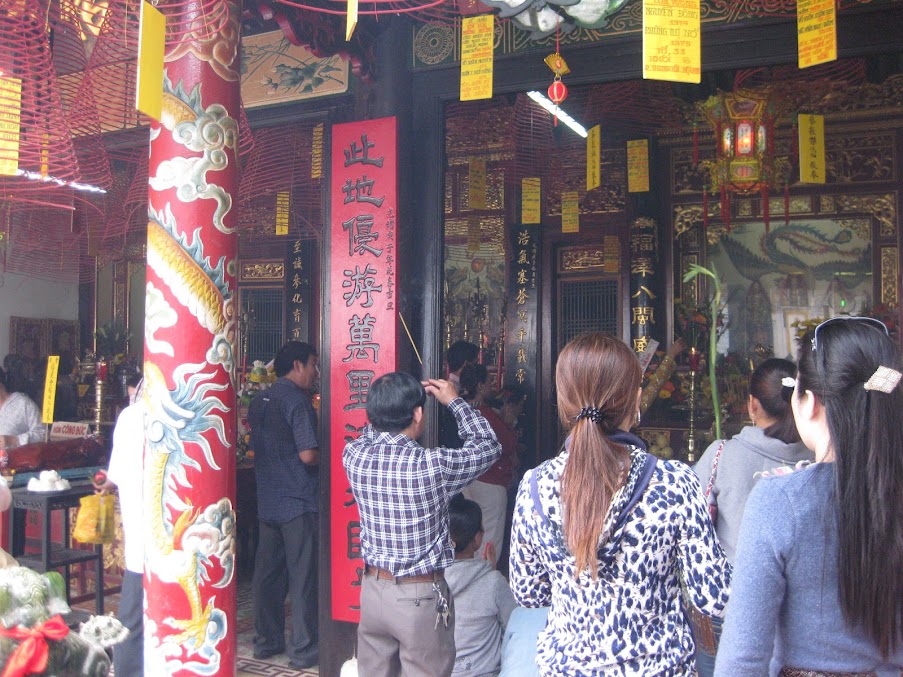
Lục Tánh Vương Gia festival (Source: Hoi An Heritage)
In addition to these major events, Fujian Assembly Hall also observes other traditional celebrations such as Tết Nguyên Tiêu (the Lantern Festival), when lanterns are displayed and prayers are offered for good fortune at the beginning of the lunar year.
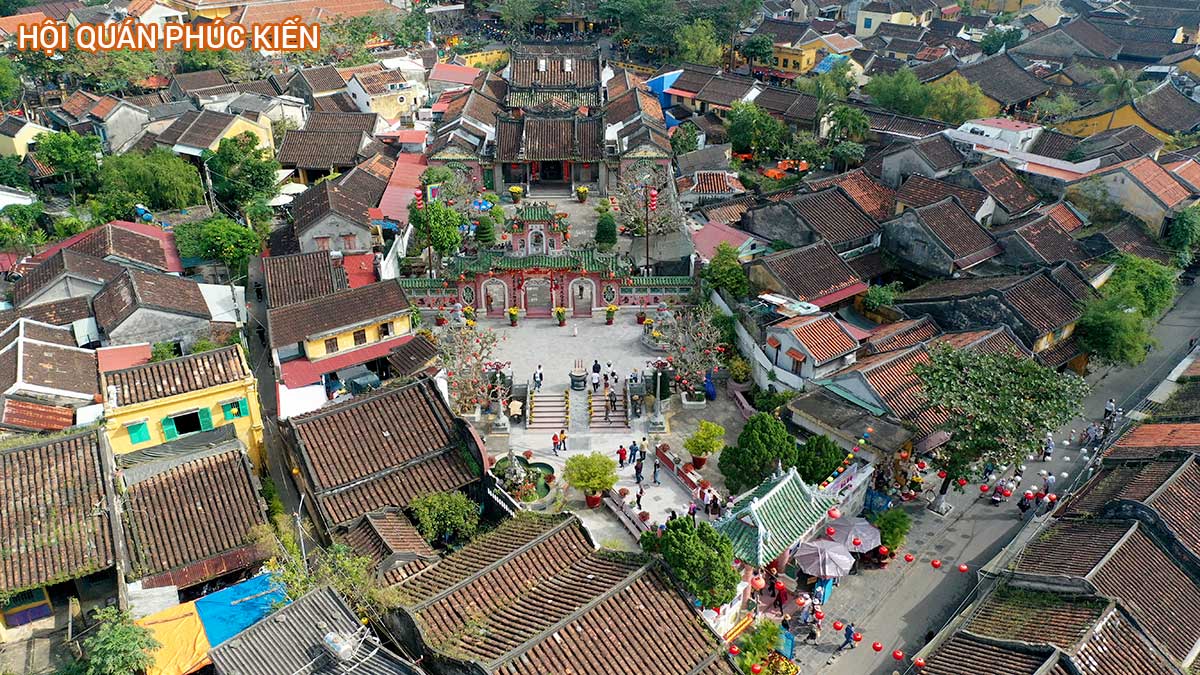
Phuc Kien Assembly Hall in Lunar New Year (Source: Hoi An Heritage)
Smaller religious observances related to childbirth, family blessings and ancestor worship are conducted throughout the year, especially at the altars dedicated to the Twelve Midwives and the Three Goddesses of Childbirth.
Through these continuous rituals and festivals, the assembly hall preserves living traditions rather than static heritage displays. For visitors, witnessing these practices offers a rare opportunity to experience the enduring spiritual values of the Fujianese community and to understand how faith, culture and daily life have remained intertwined in Hoi An for centuries.
Read more: Japanese Covered Bridge: The Timeless Icon of Hoi An
Visiting information for Phuc Kien Assembly Hall
Before planning your visit to Phuc Kien Assembly Hall, it is helpful to know the best time to explore the site and the entrance requirements. These details will help ensure a comfortable and smooth experience while discovering one of Hoi An’s most important cultural landmarks.
Best time to visit
The ideal time to visit Phuc Kien Assembly Hall is early in the morning or late in the afternoon, when the weather is cooler and the number of visitors is lower. Morning visits also allow travelers to witness local worshippers offering incense, creating a more authentic and tranquil atmosphere. During the summer months, it is advisable to avoid visiting around midday due to intense heat.
Entrance fee
Phuc Kien Assembly Hall is part of the Hoi An Ancient Town heritage complex and visitors are required to purchase an entrance ticket:
- Vietnamese visitors: around 80,000 VND per person
- International visitors: around 120,000 VND per person
The ticket is valid for 24 hours and grants access to the assembly hall along with several other historical sites within Hoi An Ancient Town.
Attractions near Phuc Kien Assembly Hall
Thanks to its central location on Tran Phu Street, Phuc Kien Assembly Hall is surrounded by many of Hoi An Old Town’s most significant heritage sites. After exploring the assembly hall, visitors can easily continue their journey on foot to discover nearby attractions that together paint a fuller picture of Hoi An’s cultural and architectural legacy.
Just a short walk away is Hoi An Central Market where the lively atmosphere reflects the town’s long-standing role as a trading port. Nearby, the iconic Japanese Covered Bridge stands as a symbol of the multicultural exchanges that shaped Hoi An from the 16th century onward. History enthusiasts may also wish to visit Tan Ky Old House, a well-preserved merchant residence that reveals how Chinese, Japanese and Vietnamese influences merged in traditional architecture.
Other notable sites within walking distance include the Cantonese Assembly Hall, which offers an interesting comparison to Phuc Kien Assembly Hall in terms of layout and decorative style, as well as several historic streets along the Thu Bon River, where lantern-lit evenings provide a serene contrast to the daytime bustle.
Together, these nearby attractions allow visitors to experience Phuc Kien Assembly Hall not as an isolated monument, but as part of a closely connected heritage landscape within Hoi An Old Town.
Best local foods near Phuc Kien Assembly Hall
Thanks to its central location in Hoi An Ancient Town, Phuc Kien Assembly Hall is surrounded by many iconic local eateries. After sightseeing, visitors can easily explore some of the town’s most famous traditional dishes within walking distance.
Banh Mi Phuong - Famous Hoi An Banh Mi
- Address: 2B Phan Chu Trinh Street, Cam Chau Ward, Hoi An
- Opening hours: 7:00 AM - 7:30 PM
- Price range: ~20,000 - 40,000 VND
Banh Mi Phuong is one of the most internationally recognized food spots in Hoi An, frequently featured in global travel media. The crispy baguettes are filled with a wide variety of meats, pâté, fresh herbs, pickles and the shop’s signature homemade sauce. Each sandwich offers a perfect balance of textures and flavors, making it an ideal quick bite after visiting the assembly hall.

Banh my Phuong (Source: VnExpress)
Thanh Cao Lau - Traditional Cao Lau Noodles
- Address: 26 Thai Phien Street, Minh An Ward, Hoi An
- Opening hours: 7:00 AM - 7:30 PM
- Price range: ~30,000 - 50,000 VND
This small local eatery is highly regarded for serving one of the best bowls of cao lau in Hoi An. The dish combines thick, chewy noodles with char siu-style pork, crispy pork cracklings and fresh local herbs. Simple yet deeply flavorful, Thanh Cao Lau reflects the authentic culinary identity of the old town.
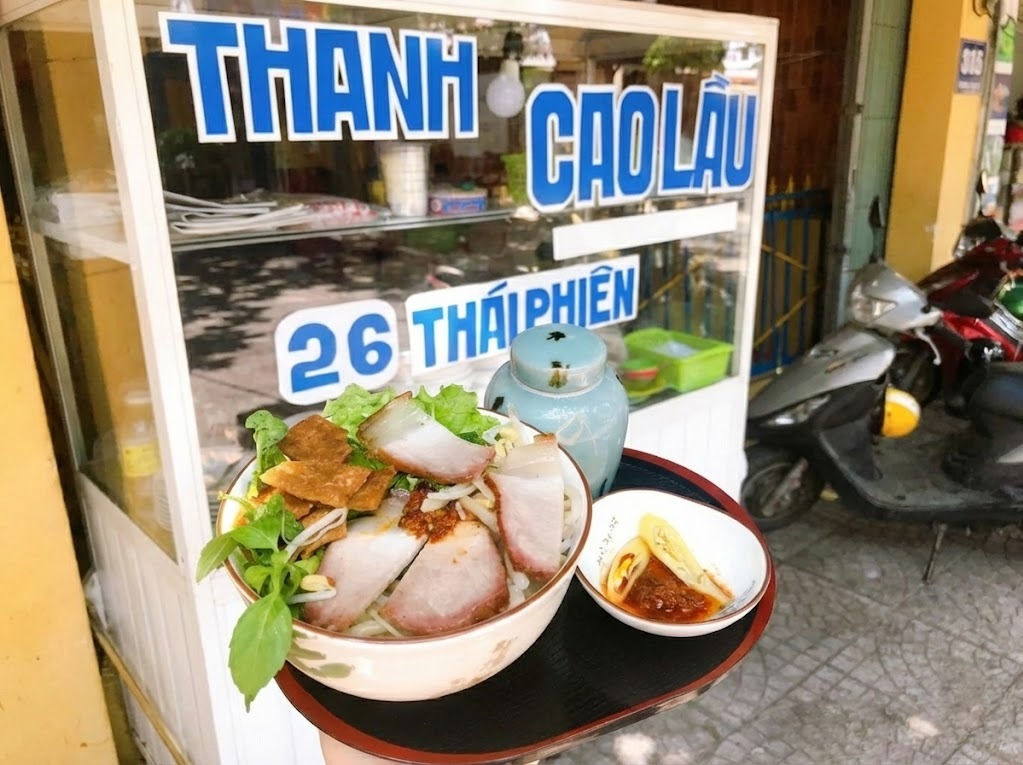
Traditional Cao Lau noodles (Source: Fanpage of Thanh Cao Lau)
White Rose Dumpling Workshop - Banh Bao & Banh Vac
- Address: 533 Hai Ba Trung Street, Cam Pho Ward, Hoi An
- Opening hours: 7:00 AM - 8:30 PM
- Price range: ~40,000 - 80,000 VND
The White Rose Dumpling Workshop is famous for its delicate banh bao and banh vac (white rose dumplings). Made from finely milled rice flour and filled with shrimp or pork, these dumplings are soft, translucent and lightly chewy. Visitors can also observe the traditional preparation process, adding a cultural experience to the meal.
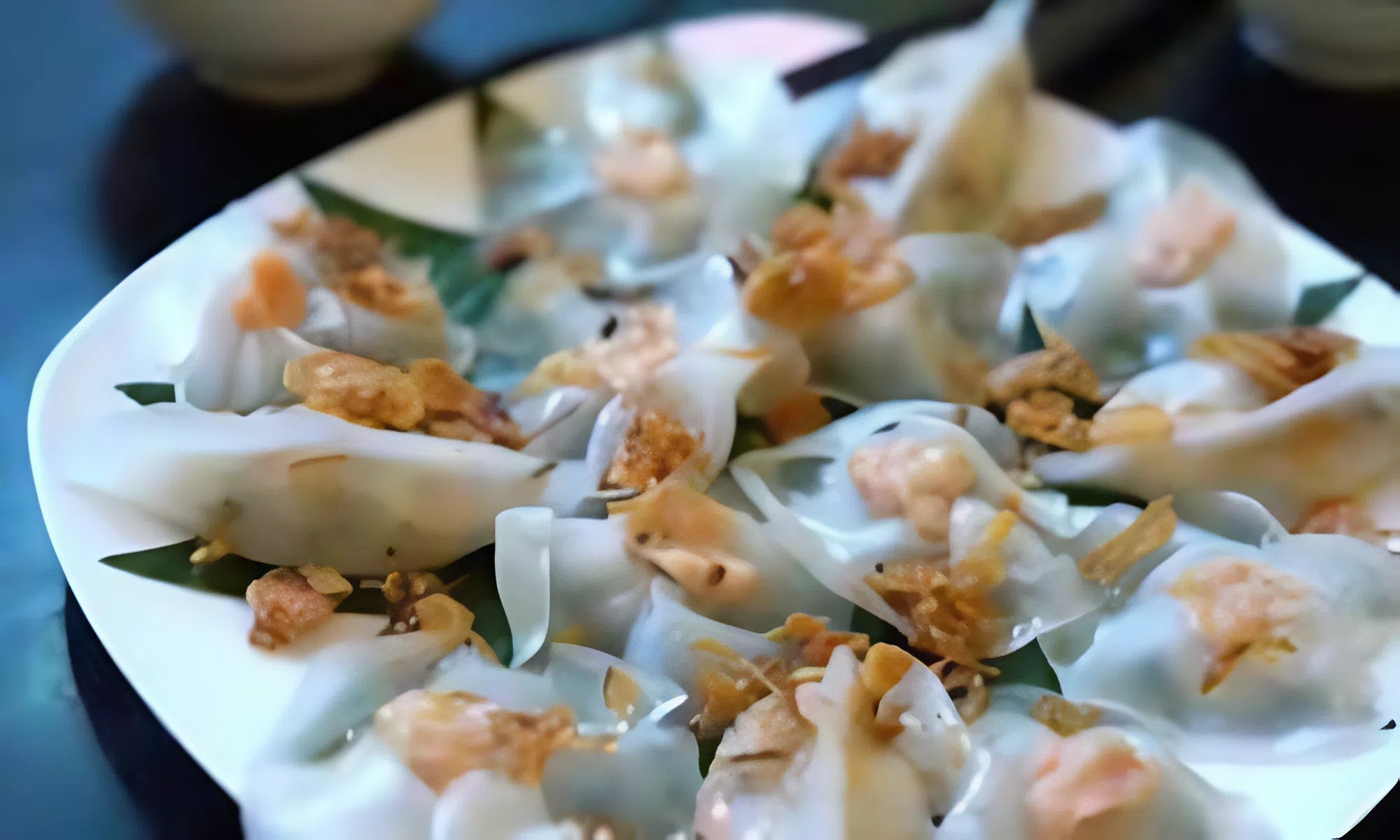
Banh Bao and Banh Vac (Source: Fanpage White Rose Dumpling Workshop)
Ba Gia Restaurant - Banh Dap & Stir-Fried Clams
- Address: Cam Nam Commune, Hoi An
- Opening hours: 8:00 AM - 9:00 PM
- Price range: ~25,000 - 25,000 VND
Ba Gia is a popular local spot for banh dap and stir-fried clams, a humble yet beloved Hoi An specialty. Crispy rice crackers are broken and eaten with savory clams seasoned with herbs and spices. Though simple in appearance, the dish delivers a memorable combination of crunch and rich flavor.
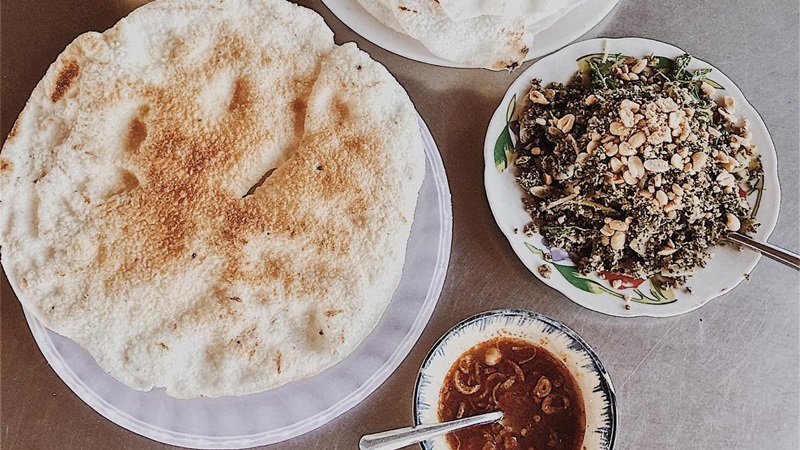
Banh Dap Ba Gia restaurant is the most popular restaurant about Banh Dap
Gieng Ba Le Pancake Restaurant - Central Vietnamese Banh Xeo
- Address: 45/51 Tran Hung Dao Street, Minh An Ward, Hoi An
- Opening hours: 8:00 AM - 10:00 PM
- Price range: ~30,000 - 60,000 VND
This restaurant is well known for its crispy Central Vietnamese banh xeo. The pancakes are filled with fresh shrimp and pork, then dipped in a rich, nutty sauce made from soy sauce, peanuts, sesame and pork liver. The combination of crunchy texture and bold flavors makes it a favorite among both locals and visitors.

Banh Xeo Gieng Ba Le
A Roi Seafood Restaurant - Fresh Seafood by the Beach
- Address: Cua Dai Beach, Hoi An
- Opening hours: 4:00 PM - 10:00 PM
- Price range: Varies depending on seafood selection
Located near Cua Dai Beach, A Roi Seafood Restaurant offers fresh seafood displayed in tanks, allowing diners to choose ingredients on the spot. Popular dishes include garlic fried shrimp, fish porridge, jellyfish salad and fish sauce fried squid. With its seaside setting and fresh flavors, this restaurant is ideal for an evening meal after a day exploring Hoi An.
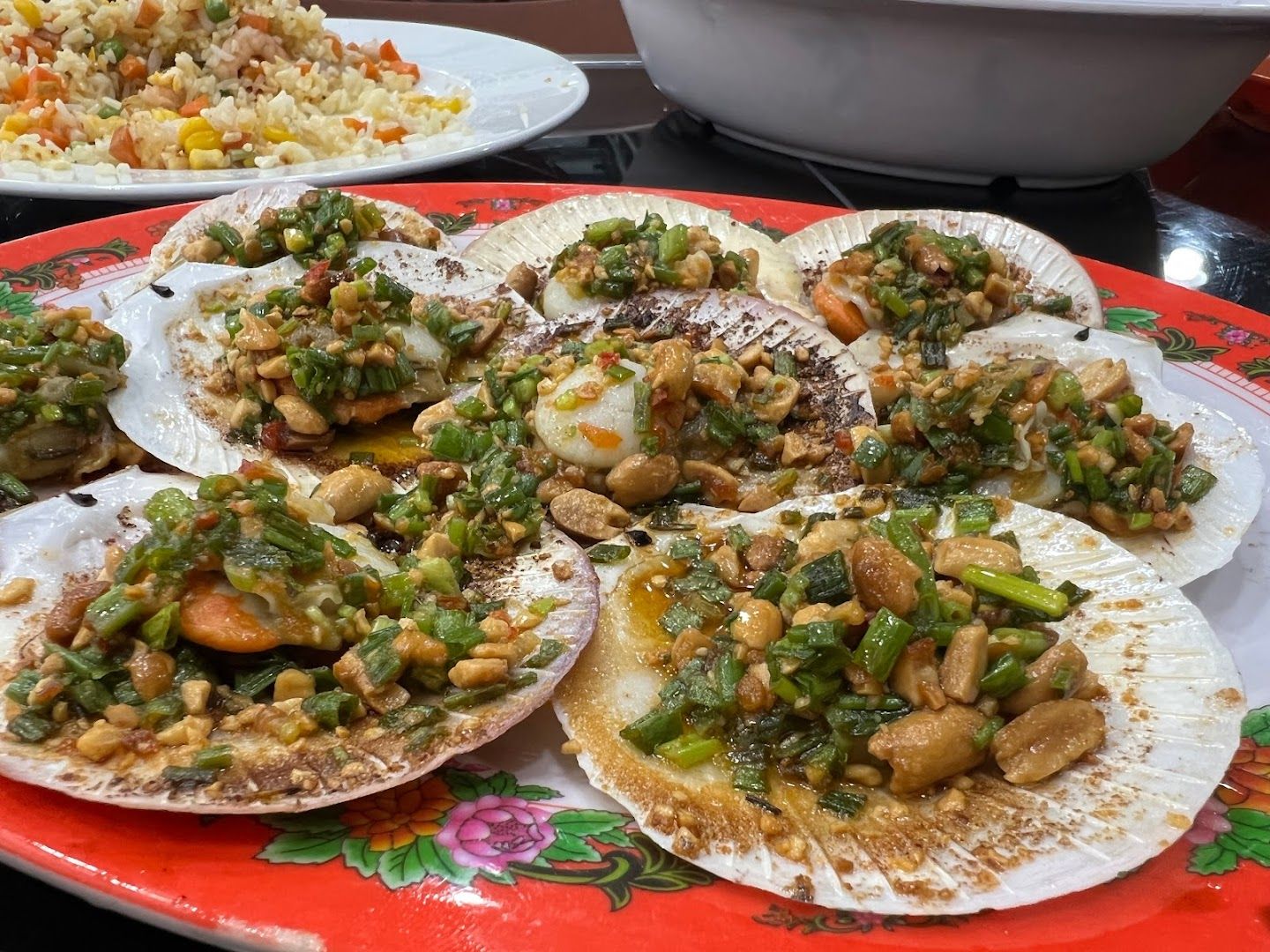
Fresh seafood at A Roi Restaurant
Read more: Hanoi Street Food: Top extremely attractive dishes
Useful tips when visiting Phuc Kien Assembly Hall
As Phuc Kien Assembly Hall is both a historical site and an active place of worship, visitors should observe certain etiquette to ensure a respectful and meaningful visit.
- Dress modestly and appropriately: Avoid short shorts, short skirts, or sleeveless tops, especially when entering the main worship areas.
- Do not bring food or drinks inside: Eating and drinking are not allowed within the assembly hall’s sacred spaces.
- Keep noise to a minimum: Speak softly and avoid loud conversations to maintain the tranquil atmosphere.
- Be respectful when taking photos: Photography is generally permitted, but avoid using flash near altars and sacred objects.
- Do not touch historical artifacts: Many statues, incense burners, plaques and decorations are centuries old and should only be viewed.
- Follow proper incense etiquette: If you light incense to pray, use an odd number of incense sticks and place them neatly in designated holders to show sincerity and respect.
- Visit during quieter hours: Early morning or late afternoon offers a calmer environment and a more pleasant experience.
- Observe rituals quietly: Local worshippers visit daily, watch respectfully and avoid interrupting prayers or ceremonies.
FAQs about Phuc Kien Assembly Hall
Below are some frequently asked questions that help visitors better understand the historical, cultural and practical aspects of Phuc Kien Assembly Hall when exploring Hoi An Ancient Town.
What is the meaning of Phuc Kien Assembly Hall in Hoi An’s history?
Phuc Kien Assembly Hall represents the early settlement of the Fujianese Chinese community in Hoi An and reflects the town’s past as a major international trading port. It served as a communal, cultural and spiritual center for Chinese merchants who contributed significantly to Hoi An’s economic and cultural development.
Who is worshipped at Phuc Kien Assembly Hall?
The main deity worshipped here is Thiên Hậu Thánh Mẫu (Mazu), the Goddess of the Sea, believed to protect sailors and merchants during sea voyages. The hall also honors other deities and historical figures such as Thiên Lý Nhãn, Thuận Phong Nhĩ, Lục Tánh Vương Gia, the Twelve Midwives and the Three Goddesses of Childbirth.
Is Phuc Kien Assembly Hall suitable for children and elderly visitors?
Yes, the assembly hall is suitable for both children and elderly visitors. The space is easy to navigate, relatively quiet and not physically demanding. However, as it is a sacred site, visitors should maintain respectful behavior and supervise children carefully.
How does Phuc Kien Assembly Hall reflect Chinese influence in Hoi An?
The hall showcases strong Chinese influence through its traditional architecture, feng shui-based layout, red color scheme, ceramic decorations, Chinese inscriptions and religious practices. These elements highlight the lasting cultural heritage of the Fujianese community in Hoi An.
Can Phuc Kien Assembly Hall be visited together with other assembly halls in one route?
Yes, Phuc Kien Assembly Hall is located in the heart of Hoi An Ancient Town and can be easily combined with visits to other nearby Chinese assembly halls within a single walking route, making it convenient for visitors to explore multiple heritage sites in one trip.
Phuc Kien Assembly Hall stands as a quiet yet powerful reminder of Hoi An’s multicultural past, where architecture, belief and community life have intertwined for centuries. Walking through its courtyards and shrines allows visitors to feel the spiritual depth and historical continuity that still shape the old town today.
If you are looking for reliable guidance as you continue discovering Vietnam’s heritage destinations, Sinhcafe has long been a trusted companion for travelers exploring the country with confidence. You can reach us at +84 904 488 850 or +84 24 3756 8868 for practical travel advice, local insights, and thoughtful suggestions to help shape a journey that feels both enriching and well-prepared.
Share via




Related articles

Vung Tau port: Discover the bustling port life and exciting activities
Blog | 20/08/2025

Exploring the best time to visit Ha Long Bay
Blog | 30/12/2025
Phát Diệm cathedral: Discover the Majestic Phat Diem Stone Cathedral in Ninh Binh
Blog | 30/12/2025
Nha Trang Cathedral: The Gothic Soul Anchored in the Heart of the Coastal Pearl
Blog | 30/12/2025









There are no reviews yet